Browsing Category

Thinking Maps

Schema – Text to Text Connections

Anchor Charts, Debbie Miller, Reading with Meaning, Thinking Maps

So this post has taken me way too long to write.  Things got super busy at school with data week and open house so unfortunately posting for the last week or two has gone by the wayside.

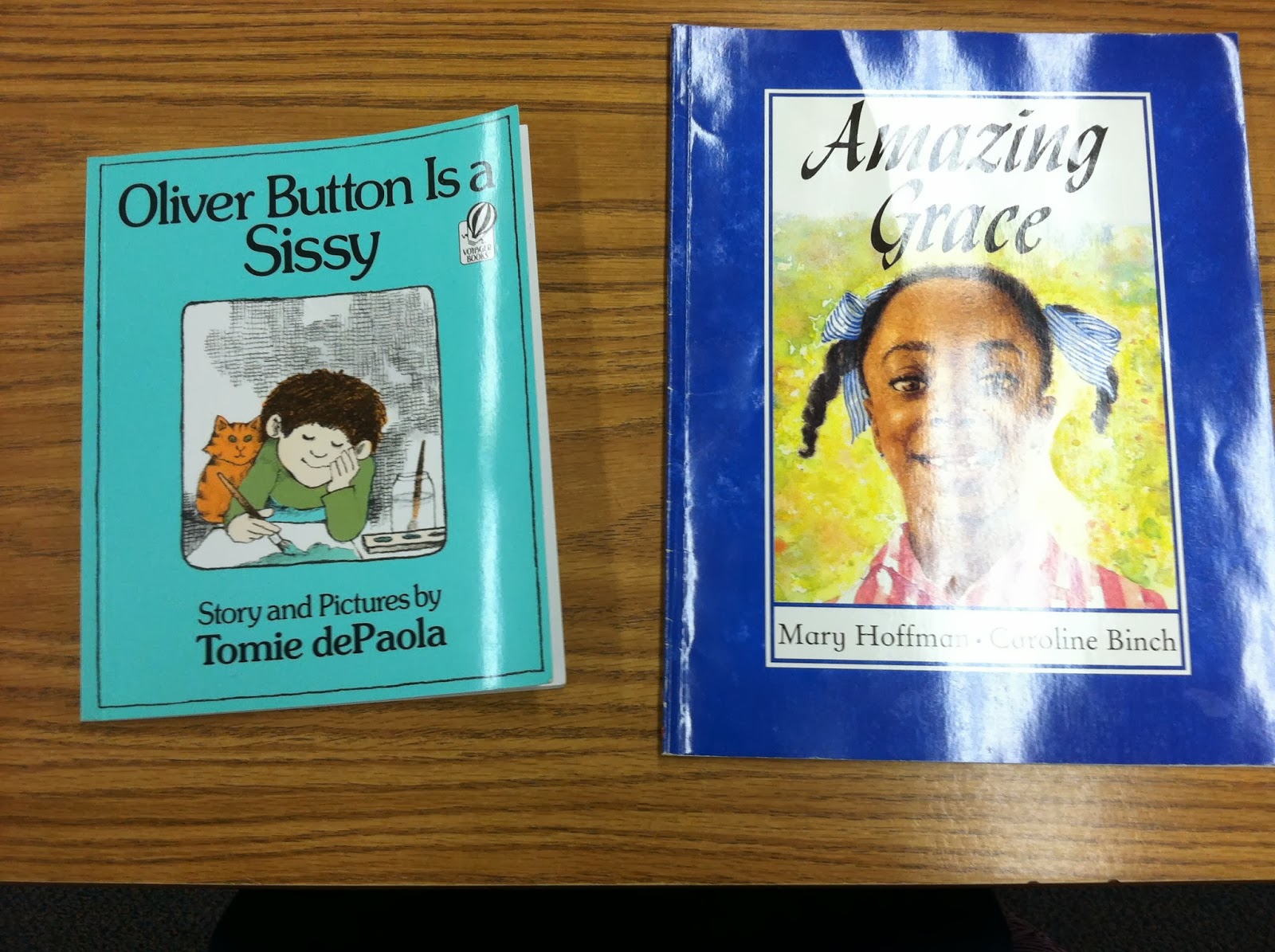
Anyways…here is the schema post I mentioned about two weeks ago.  We’ve been focusing a lot on schema in my second grade classroom.  I use Debbie Miller’s, Reading with Meaning for ideas.  My last post/recent post was about Oliver Button is a Sissy and coming up with text to self connections.  The day following Oliver Button, we read the story Amazing Grace.  We then made text to text connections between the two stories.  To show our text to text connections we used a double bubble map. 

 
The kids did a great job with coming up with similarities and differences between the two books.  The double bubble map also showed it perfectly and I love being able to color coordinate things :-)!
Happy almost Friday!

Anchor Charts Galore

Anchor Charts, Phonics, Reading, Reading with Meaning, Thinking Maps

Well, as I mentioned in my last post, I’m trying to blog more – and yay – this is two days in a row. I also said I’d write a post about my introductory math stations.  That was the goal, but monthly benchmark testing got in the way today. So…instead of math stations – I have anchor charts galore for you to show you a few things we’ve been working on.

Anchor Chart #1 – All week we have been doing a review of short vowels in addition to working on words with consonant blends. Below you’ll see a tree map used to categorize different words depending on their short vowel.


Anchor Chart #2 – Schema Chart. Today we read the story, Super Completely and Totally the Messiest by Judith Viorst. First of all, super cute story! The kids really identify with the messy character, which is what makes this story perfect for teaching schema – text to self.  My schema set-up comes from Debbie Miller’s, Reading with Meaning.  I shared my schema during a think aloud while reading. The kids then pair shared and shared their connections. Then, they shared out and we charted it.  Soon they’ll be ready to start writing connections on their own.


Anchor Chart #3 – In writing today, we started to review nouns. I asked the class at the beginning who had heard of nouns back in first grade.  Well, that response was scary. I got a lot of 2nd graders shaking their heads no, some with confused looks, and a lot of kids with their thumb down.  So, we moved on and watched a little clip on Brainpop Jr to either introduce it or review it. We then came up with our own list of nouns (which all happened to be common) and used a tree map to organize our thinking.  By the end, we had a basic understanding of nouns and/or a quick review to get us back up to speed. 


Happy Wednesday! Only two more days til the weekend!

Using Thinking Maps in Math

Math, Thinking Maps

As most of you may know after reading previous blog posts, I’m a big fan of thinking maps. Well, lucky for me, my new school uses thinking maps too!  So, today we started using thinking maps in math.  Our assignment in Everyday Math was to show how numbers have equivalent forms and that there is more than one way to write a number. Well this fits in perfectly to thinking maps and perfectly into differentiation. 

Here we made a circle map as a class coming up with numbers that equaled 10.  This was my time to model how to do the activity and also show kids how there are many ways to come up with a number. I love when they start to see that it doesn’t just have to be two numbers added together – that it could be 5+2+3 and I love when they see the various subtraction sentences too.


Here’s a student sample. I gave each partnership a different number. For my kiddos who have a hard time with math, I gave them a number below 10 – 7, 8, 9

 
*Disclaimer* Unfortunately, we didn’t get a chance to finish these in our math block so you are just seeing the beginning stages.
 
 
For my kiddos, who are ready for more of a challenge I gave them numbers in the teens up to 20.  Eventually this activity will be moved into math stations and kids can choose from a variety of numbers – especially friendly numbers – 20, 30, 40, 50, etc. to get them familiar with using those friendly numbers throughout math.

 
My goal is to post more during the week and with school getting into full swing that has been a little difficult. But, I’m hopeful tomorrow to have a post on my introductory math stations.  Have a great night!

Compare and Contrast – Part 2

Reading, Thinking Maps

After spending time comparing and contrasting objects, we moved on to comparing people.  To introduce comparing and contrasting people, my student teacher and I decided to have the kids compare us.  So we gave them some time to come up with similarities and differences and then had them share out.  They know us pretty well and some of their responses were pretty funny. For example, one of my kids said the student teacher wears make-up and I don’t. Little do they know I do and it would be a scary sight if I didn’t lol.  To chart our similarities and differences we used a double bubble – see below…


The next day we gave the kids a chance to complete a double bubble map with a friend. Since they saw the student teacher and I model the double bubble the day before, they were familiar with the activity.  They had a lot of fun seeing what was similiar and different about each other and did a great job working together and completing a double bubble map.  See examples below…


American Symbols Bulletin

Bulletin Boards, Social Studies, Thinking Maps

My student teacher came up with a great idea to display some of the different activities we completed with each American Symbol.  Below you will see the circle map for each symbol and a few examples of the activities that went along with each symbol.


Compare and Contrast – Part 1

Reading, Thinking Maps

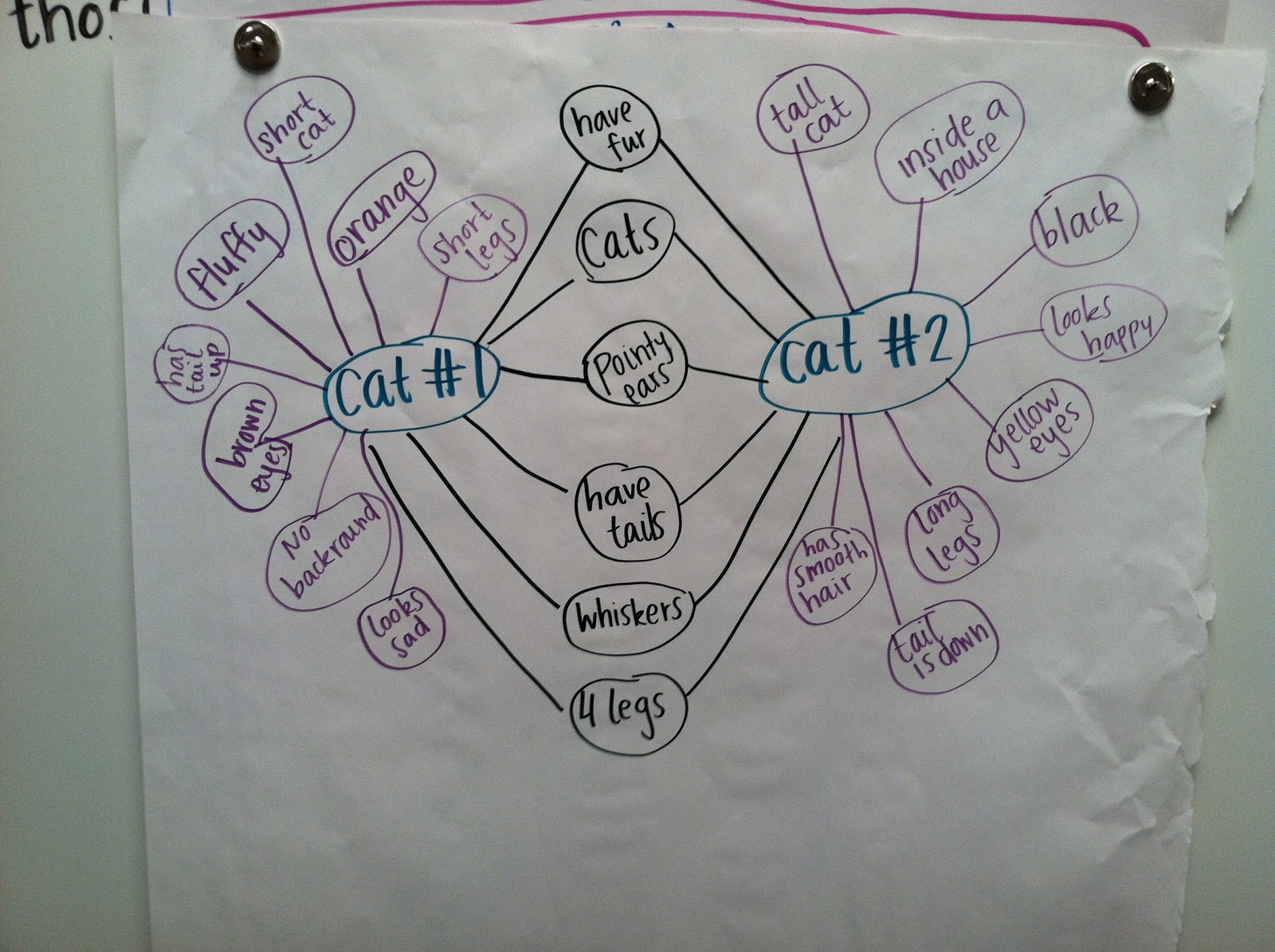
This week in first grade we started tackling the Common Core Reading Standard – 1.RL.9 – Compare and contrast the adventures and experiences of characters in stories.  To start teaching this standard, I decided to use real life objects to get the kids used to comparing and contrasting before we started using text for our comparisons.  On the first day, we talked about the definitions of compare and contrast and things you could compare and contrast – people, books, movies, characters, TV shows, food, etc.  Then, we looked at a SmartBoard file with a picture of two cats. The kids had to discuss things that were similar about the two cats and things that were different. To chart our results we used a double bubble map – see below…

SmartBoard File with Cat Pictures
 
Double Bubble Map for Comparing and Contrasting Cats
 
 
On the second day, we reviewed comparing and contrasting and reviewed the lesson from yesterday. Then, we showed the kids pictures of two dogs.  Again we discussed similarities and differences between the two dogs and reviewed how to set up a double bubble map. After review, the students took the activity a step further and created their own double bubble maps. See examples below…
 

 SmartBoard File with Dog Pictures
 
Student Examples:


White House – American Symbols Unit

Informational Text, Report Writing, Social Studies, Thinking Maps

So our first grade team took on a huge project and it went so well! American Symbols is one of our social studies standards and with the huge increase in informational text we decided to create a huge unit on it.  Each teacher took a symbol – White House, Statue of Liberty, Washington Monument, American Flag, and Bald Eagle. Then, we came up with a PowerPoint, books to use, stations etc.  My symbol was the White House – see my ideas below…

First, I started out by showing this fun video of a student interviewing President Obama. I started off by telling the kids that we had a mystery symbol today and they had to guess what it was.  They loved the suspense and love the video. The video was about 10 minutes long so I picked out the appropriate parts that I thought they would enjoy. 

Next, we watched a PowerPoint that I made on the White House. This PowerPoint focused on the main facts that I wanted my first graders to come away knowing.  After the PowerPoint, we started a whole group circle map putting up details from the PowerPoint.  Then, we read a nonfiction book about the White House and again added more facts. 

See our White House Class Circle Map….

After working our class circle map, the kids made their own that they added to throughout the day.  Then, it was time to move on to our White House Stations.
 
Station #1 – Informational Text
Students looked through a variety of White House books (different text levels) and added more facts to their circle maps. 


Station #2 – Writing Activity
Students write a story about what life would be like if they lived in the White House.


Station #3 – Word Search
Students highlight the presidential words.


Station #4 – World Book Kids Article
Students read a White House article printed from World Book Kids online and highlighted key facts.


Station #5 – White House Virtual Tour

The White House has a great website with a virtual tour of the White House. The kids can see a map of the White House and see pictures and information on the various rooms. This is a kid favorite station!


After completing their circle maps, on day #2, the kids wrote a report on the White House using their circle map information. 
 
 
Once we were all complete with our report on each symbol, students picked their favorite symbol to do a technology project on using the program “Frames.” Our wonderful district Ed Tech is helping us out with this. 
 
So, overall, this symbols project incorporates – reading standards, writing standards, social studies standards, listening and speaking standards, and technology standards.  Love it!
 
 
Below are some student circle maps…


Brave Irene – Setting Brace Map

Literary Elements, Thinking Maps

Over the last week, we started reviewing literary elements again.  Identifying the setting was the one area of literary elements that our first graders struggled with the most.  On Friday, we read the story Brave Irene (great story by the way) and came up with the 3 settings from the story.  We used a brace map to display the settings and then added evidence that supported the setting identifiation. The kiddos did great with it.  See below….

Literary Elements – Problem and Solution

Literary Elements, Thinking Maps

For the last part of our literary elements focus, for now, we focused on finding the problem and solution in a story.  As the two weeks of instruction went on, the kids really seemed to grasp the concept of finding a problem or problems in a story and then figuring out how the problem was solved. 

To teach problem and solution, I used some of the following picture books:

  • Wemberly Worried
  • Harry the Dirty Dog
  • The Three Little Javelinas
  • Prudy’s Problem and How She Solved It
  • The Kissing Hand

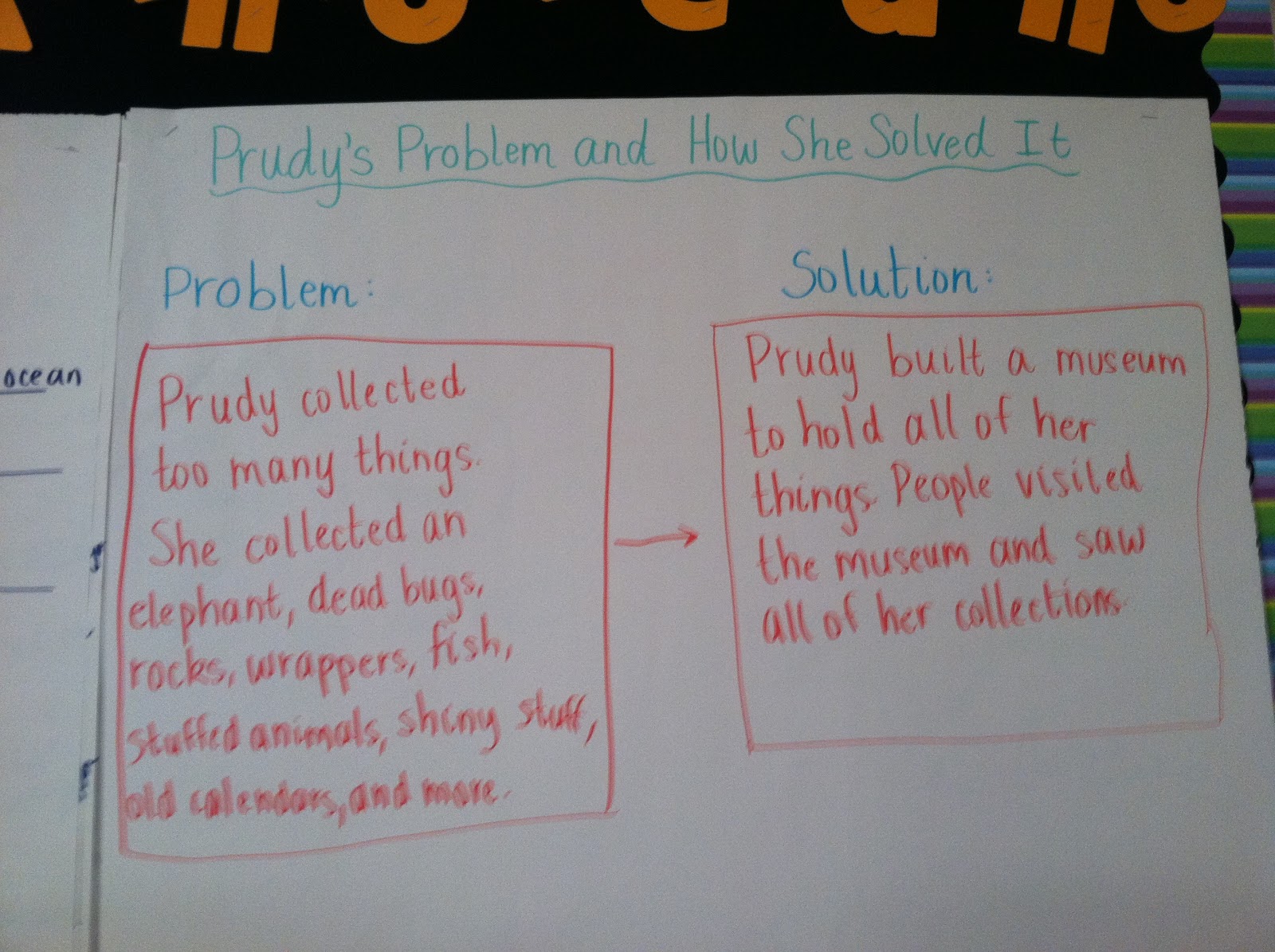
For showing problem and solution during whole group instruction, we used a flow map (thinking maps).  See two examples below.

For the story, Prudy’s Problem and How She Solved It:

For the story, The Three Little Javelinas:


To assess our kiddos, we used a simpler form.  It had a space for a picture of the problem and a picture of the solution at the top. Then, the kids had to fill in the following sentence frame “The problem in the story was…” and “The problem was solved when…”
 
 
This upcoming week, I’m super excited because we are starting our informational text study and will be making Nonfiction Conventions Notebooks from Debbie Miller’s, Reading With Meaning. More posts coming soon on this!

Got 5 minutes….

Reading, Thinking Maps

So you know that time in your day where you have about 5 minutes until it’s time to go to recess or about 5 minutes until you need to move onto the next activity, but it’s too soon to really get started on something else.  Well, here’s an activity I often use as a filler in my room.  It’s quick and also still educational! Each week we learn a new sound/spelling in first grade with our reading program.  Since our school is Thinking Maps trained one of the activities I throw in as that quick five minute filler is making a circle map with our sound/spelling of the week. It’s a quick activity, allows for each child to participate and be engaged, and gives kids an opportunity to review and practice our reading sound of the week.