Browsing Category

Math

Place Value – 2.NBT.1

Common Core, Math, Math Stations, TPT

Last week, we studied place value specifically the standard 2.NBT.1.  I found a ton of great games and ideas on TPT and even created a few to help my kiddos out.

To start off, we made an anchor chart with some place value examples and things to remember. 

 
Then, after a 4 day study and introduction to the different activities below, we had place value stations on the fifth day. The kiddos loved it!
 
Station #1 – Show Me the Number – this is an activity I created and can be found on my TPT store, here.  This activity offers chances for kids to practice working with 2 digit and 3 digit numbers.  Students can build the numbers using base 10 blocks, draw a place value model, write the number in word form, expanded form, etc.  This provides students with a chance to practice working with multiple numbers.

 
Station #2 – Write the Room – Place Value.  Students got to get some movement in and find the different values of the numbers around the room. I found this on TPT at Shuna Pocket Full of Kinder’s Store – this activity is called Place Value Rock.

 
Station #3 – While this picture is upside down, the station was still too great to not share.  This game was called “Mystery Number” and can be found in Love to Learn’s TPT store, here.


Station #4 – Roll It, Make It, Expand It can be found at Rebecca Anderton’s TPT store, here.  Great chance for students to practice writing the number, modeling it, and expanding it.

 
Station #5- Digit Game – This is a game from our Everyday Math Unit. Students play with a partner and each turn over two cards.  With the 2 cards they have, they need to make the largest number possibly (for example, 28 or 82 – they’d choose 82). The student with the larger number wins.  You can also differentiate this game by having students flip over 3 cards so they need to make the largest 3 digit number.

 
Station #6 – Miss V – Students were put into groups based upon levels. When students met with me, we worked on place value skills that they needed practice on or started to challenge with expanded notation.
 
 
Thanks for checking out my place value ideas.  Be sure to check out – Show Me the Number in my TPT Store.


Graphing

Math, TPT

Graphing is one of my favorite math concepts to teach.  I found some great ideas online to get it up to 2nd grade level and also created a 2nd Grade Graphing packet that can be found on TPT ($1.50).

The first thing that made a huge difference in my kids understanding of graphing was using Teaching from the Core’s idea to help kids understand the term difference.  Every year when I was teaching first grade, the kids were great with representing data, great with answering questions like which had the most, how many had this, etc – but when it came to how many more or how many fewer did one graph item have over the other….it was a disaster.  So, while reading through all of my favorite blogs I stumbled upon her post.  You can check it out here…  I used it this year with my 2nd graders and they got it! And, what a fun way to learn it.

Another great item I stumbled upon was Sunny Day’s in 2nd Grades Math Common Core Assessment Packet.  This thing is fantastic! There are 3 math pages for each Common Core Standard. I purchased it and have loved using it! I use one of the pages as a pre-test so I know what areas I need to focus on when teaching the standard, another page as homework, and the last page as the post-test. 

Now, on to graphing… 

In my graphing packet, you’ll find some practice pages, where students need to take the tally graph data, turn it into a bar graph, and then answer questions about the graphs.

You’ll also find a Favorite Book graph. This is a great way for a whole class activity or a survey activity that students could do independently. I used this activity whole group and we asked each student in the class, which book was their favorite and filled in the tally graph accordingly.  The kids had a lot of fun and I love when we can represent them and their opinions in the graph.

The next graph was a fan favorite of the kiddos. This was during Halloween week so I bought some of those fun size Skittle bags and we graphed the colors they found in their bag.  Their favorite part…eating them when they were done graphing.  My favorite part…seeing that they were getting the concept of representing data and how to use it to answer questions.

The last graphing activity we did before the post test was a survey of the class. This turned out better than I imagined.  First, we came up with possible survey questions that kids would maybe want to ask each other. Afterwards, the students fill out their survey question sheet with a question they wanted to ask their fellow students and the four answers that would go with it. They loved this! Afterwards, they got to go around the room and ask each student their question and represented their response in their tally graph. Once their tally graph was filled out, they transferred the tally graph information into the bar graph and answered the questions. For my students that finished early, I challenged them to come up with other questions they could ask about their graph on the back of their page.


Please check out my Graphing Packet in my TPT Store!!
 
Hope everyone is having a great long weekend!

Doubles Math Station and Fact Family/Addition Station

Math, Math Stations, Thinking Maps, TPT

Again, I’m a few weeks behind, but I still figured why not share.  A few weeks ago we spent time learning about doubles and fact families in math. I found and created some great activities that I wanted to share with you.

Double Math Station

I found this great game Dinosaur Doubles from Oceans of 1st Grade Fun.

I can’t remember where I found these cards, but I found a doubles memory game that I then glued to cardstock. The kids love playing this!

Here is a Doubles Tree Map activity that I created. You can find it as a freebie in my TPT store, here.  This activity gives kids a chance to practice their facts, learn some vocab, and use the tree map to organize their doubles facts.
 
 
Another station I added, included this great Fact Family Triangle I found at This Reading Mama’s Blog.


And, my last game addition is a math game from Everyday Math. Students start their counters at 1 and roll the die to move up. The first person to 120 wins. The neat thing about this game though is if you roll a 1, you can choose to move 1 or 10. If you roll a 2, you can choose to move 2 or 20. It’s a great way to start adding up 10’s from different numbers.


These are a few of the additions to my math stations. Stay tuned for more as the year continues and please check out my Doubles Tree Map freebie in my TPT store.
 

Teaching about Money

Math

We’ve begun to talk about money in 2nd grade. Now, before I started my money unit, I gave my students a pre-test to see where we are at and what we knew. I found a great pre-test on Teachers Pay Teachers.  So, I gave the pre-test and found out quickly that we really don’t know money and that we were going to have to start from square 1. 

So, we began by identifying coins and their values.  We used a bubble map for each coin – penny, nickel, dime, and quarter and described things we knew about that coin.

We then practiced coins by coin type. Counting pennies by ones, nickels by fives, dimes by tens, etc.  I came up with a few practice pages to see how the kids were grasping the counting. On these practice pages, I included some with the coins, some with words, and a story problem since the 2nd grade standard primarily focuses on story problems.

 
We also watched some Brainpop Jr movies on money and read the story How Much is a Million.
 
We definitely still have work to do with money to get where we need to be to cover the 2nd Grade Common Core Standard, but we’re getting a little closer each day.
 
Happy Friday!

Place Value Strategy for Problem Solving

Math, Story Problems, TPT

We’ve been working through the story problems in my October Story Problem Packet, which can be found on TPT here.  There are a variety of add to, take from, part/part whole, and multiplication and division problems. We’ve been focusing on the straightforward addition and subtraction problems so far, but this week we’re going to try some of the others.

Here are some of our problems…

Prompt: ___ spiders were hanging from the web.  _____ more spiders crawled over.  How many spiders are in the web now?  Number Choices: (23, 20), (43, 41), (67, 52)


What I love about these is students can choose a number choice that works for them. One that challenges them, but doesn’t challenge them so much they get frustrated.  I also love seeing all of the kids using the place value model to solve their problem. We’ve been doing a lot of review of place value with tens and ones and I’m happy to see them applying it to story problems too.
 
If you’re interested in some October Story Problems to use in your class, check out my packet on TPT here.


October Story Problems – Now on TPT

Math, Story Problems, TPT

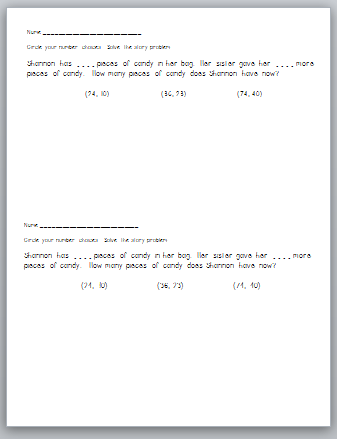
I finished up my second story problem packet called October Story Problems.  This packet has 16 story problems.  There are 4 Add To, 4 Take From, 4 Compare, and 4 Equal Groups.  I used equal groups and compare to up the challenge a bit for kids and classes who are ready for it. In addition to the various problem types, there are three number choices for each problem, which lends to easy differentiation.  I also have two formatting methods. A cute full page with clipart and a half page, which makes for easy copying with limited copy numbers.  See a few pages below and be sure to check it out at my TPT store here.


Be sure to check it out at my TPT store.
 
Happy Sunday everyone!


Using Thinking Maps in Math

Math, Thinking Maps

As most of you may know after reading previous blog posts, I’m a big fan of thinking maps. Well, lucky for me, my new school uses thinking maps too!  So, today we started using thinking maps in math.  Our assignment in Everyday Math was to show how numbers have equivalent forms and that there is more than one way to write a number. Well this fits in perfectly to thinking maps and perfectly into differentiation. 

Here we made a circle map as a class coming up with numbers that equaled 10.  This was my time to model how to do the activity and also show kids how there are many ways to come up with a number. I love when they start to see that it doesn’t just have to be two numbers added together – that it could be 5+2+3 and I love when they see the various subtraction sentences too.


Here’s a student sample. I gave each partnership a different number. For my kiddos who have a hard time with math, I gave them a number below 10 – 7, 8, 9

 
*Disclaimer* Unfortunately, we didn’t get a chance to finish these in our math block so you are just seeing the beginning stages.
 
 
For my kiddos, who are ready for more of a challenge I gave them numbers in the teens up to 20.  Eventually this activity will be moved into math stations and kids can choose from a variety of numbers – especially friendly numbers – 20, 30, 40, 50, etc. to get them familiar with using those friendly numbers throughout math.

 
My goal is to post more during the week and with school getting into full swing that has been a little difficult. But, I’m hopeful tomorrow to have a post on my introductory math stations.  Have a great night!

Story Problems

Math, Story Problems, TPT

I love teaching story problems.  When I was a kid, I actually despised doing them. Something about seeing words in a math problem freaked me out. Now, after being CGI (Cognitively Guided Instruction) trained and after using story problems extensively at my old school – I love them! They are a great way to hit multiple Common Core Math Standards and a great way to get kids thinking and sharing their strategies. 

I came up with a Back to School Packet of Story Problems for 2nd graders, which is on Teachers Pay Teachers, here.  This packet could also be used for high first graders or for 3rd graders in need of some interventions.  In this packet, I have 4 story problems for each type of joining problem and 4 story problems for each type of separating problems.  In addition to the 4 story problems, each story problem has 3 presentation choices.  The story problem can be printed with a graphic, with number choices (great differentiation), or on a half sheet to save paper.  This document can be edited so you may change the numbers, names (students love to see their own names in the problems), or the problem. 

Here are a few student samples from this week in my classroom:

For this problem, my student chose to use the 10 frame to help her organize her problem. She put 25 dots on the one side and 10 on the other. Then, she counted by 10’s, 10, 20, 30 and then the 1’s, 31, 32, 33, 34, 35.  Nice number sentence too!
 
This student used the place value model to figure out this problem. I was so excited because we really focused on place value this week.  Most of my kiddos are still stuck on drawing everything out by 1’s so I was excited that this student was ready to move on to place value. She has two tens sticks and 5 ones and then another ten stick. Then, she counted the tens and then the ones and got 35. 
 
 
So, here is a little sample of my TPT creation that you can check out here…


Hope everyone has a great Saturday!!!