Browsing Category

Reading

More Analyzing Characters

Literary Elements, Reading, Thinking Maps

I posted the other day about my first analyzing character lesson using Lilly from Lilly’s Purple Plastic Purse that I saw on ReadWorks.org.  Now, this next lesson I did started with an idea from ReadWorks.org, but then took off on it’s own. To continue with the Lilly theme and see how a recurring character would be in two different stories, towards the end of last week we read Julius, The Baby of the World. Another great Kevin Henkes book – his books are fantastic for literary elements.

 
While reading we stopped a few times, once after the first page to write down Lilly’s traits, once towards the end of the middle section, and then again at the end. To show Lilly’s character traits we used a bubble map.  As we were going we saw that Lilly’s characteristics changed throughout the book.  In the very beginning, she was excited to have a baby brother.  Then, in the middle she was jealous (love that my ELL kiddos came up with that word that describes Lilly perfectly).  And, in the end, she sticks up for her brother and becomes protective.  As we were charting this together as a class and independently, I was talking with the kids about how confusing the chart looked since it said she was nice, mean, excited, grumpy, and rude.  I had an aha moment! I decided to have the kiddos and myself mark each bubble with a B for beginning, M for middle, and E for end, so we knew which part of the story we saw those traits in.  I’m sure someone has thought of this before, but it was one of those teaching moments where I was like how have I not thought of it. 
 
So, on day 1 we completed the bubble map….see examples


Then, on day 2, we took the bubble map and wrote up a little analysis as a class since it was our first time writing it. 


For our first try at character analysis I think we did a pretty good job.  Look for these lessons and lesson ideas to continue with Strega Nona next week.
 

ReadWorks.org

Literary Elements, Reading

I’m sure many of you are already using www.readworks.org, but if you’re not you have to check it out.  It is a great website that has many common core reading standards, lessons that go with it, independent practice options, etc.  It is wonderful!

My kids have really been struggling with analyzing characters and I found a great lesson on ReadWorks last week.  Using the story, Lilly’s Purple Plastic Purse you analyze Lilly looking at her actions, what she was thinking, and how she was feeling.  We stopped multiple times as we were reading through the story to fill out our “recipe” of Lilly’s personality.  To document her actions, thoughts, and feelings, we used a tree map.  See below…


We also studied Lilly further using the story Julius, The Baby of the World.  Stay tuned for that post tomorrow!
 

More Schema…Independent Practice Time

Debbie Miller, Reading, Reading with Meaning

Wow…have the last few weeks gotten away from me. I’ve taken pictures while at school, but the whole blogging thing when I got home hasn’t been happening. So, now it’s time to play catch up!

After practicing schema and text to self connections a few times whole group and through guided instruction, it was now time for independent practice.  I picked the story Ira Sleeps Over. First of all, it’s just a great story, but there are also a lot of great connection possibilities in there. Most kids have been to a sleep over, have a special stuffed animal, mean sister, or are scared of ghost stories.  Love the book and the kids loved it too (surprisingly a lot of my students hadn’t heard this one).  So, I read the story aloud and shared my connections via think aloud. Then, students pair shared their connections with each other. After sharing with each other, they wrote their own connections out still following the “When I heard the part about… it reminded me of…”  They did a great job! See an a few examples below.

“When I heard the part about Ira sleeps over, it reminded me of sleeping over at my cousins.”
 

“When I heard the part about Ira and Reggie were having a sleep over, it reminded me of when I went to my BFF house.” I love how she put my BFF’s house! How cute!


More Schema…

Anchor Charts, Reading, Reading with Meaning

Here is another schema chart that we completed yesterday. This idea and chart set-up comes from Debbie Miller’s book, Reading with Meaning, which you hear me praise a lot on my blog. 

Yesterday, we read the story Oliver Button is a Sissy.


 This book touches on a bunch of issues, but is a great one to use because at some point in these kids lives they will either be teased or have already been teased and this book definitely touches on that subject.  As I read the book, I shared my connections to the story – text to self.  When I finished reading, I had students pair share to share out their connections sitting eye-to-eye and knee-to-knee. They had a lot of great connections to this book. Then, we completed the chart seen below.  To help kids get used to providing part of the text along with their connection we use the frame “When I heard the part about _____. (which is from the text)  It reminded me of _____.(their own personal connection)”  The kids are really starting to get the hang of sharing out their connections like this.

On Monday, you’ll see this story again, but paired with Amazing Grace.  Then, we’ll be working on text-to-text connections using a double bubble thinking map.

Anchor Charts Galore

Anchor Charts, Phonics, Reading, Reading with Meaning, Thinking Maps

Well, as I mentioned in my last post, I’m trying to blog more – and yay – this is two days in a row. I also said I’d write a post about my introductory math stations.  That was the goal, but monthly benchmark testing got in the way today. So…instead of math stations – I have anchor charts galore for you to show you a few things we’ve been working on.

Anchor Chart #1 – All week we have been doing a review of short vowels in addition to working on words with consonant blends. Below you’ll see a tree map used to categorize different words depending on their short vowel.


Anchor Chart #2 – Schema Chart. Today we read the story, Super Completely and Totally the Messiest by Judith Viorst. First of all, super cute story! The kids really identify with the messy character, which is what makes this story perfect for teaching schema – text to self.  My schema set-up comes from Debbie Miller’s, Reading with Meaning.  I shared my schema during a think aloud while reading. The kids then pair shared and shared their connections. Then, they shared out and we charted it.  Soon they’ll be ready to start writing connections on their own.


Anchor Chart #3 – In writing today, we started to review nouns. I asked the class at the beginning who had heard of nouns back in first grade.  Well, that response was scary. I got a lot of 2nd graders shaking their heads no, some with confused looks, and a lot of kids with their thumb down.  So, we moved on and watched a little clip on Brainpop Jr to either introduce it or review it. We then came up with our own list of nouns (which all happened to be common) and used a tree map to organize our thinking.  By the end, we had a basic understanding of nouns and/or a quick review to get us back up to speed. 


Happy Wednesday! Only two more days til the weekend!

First Week

Debbie Miller, Reading, Reading with Meaning

Wow….what a crazy, busy first week. It’s been a long time since I’ve been brand new at a school and let me tell you the first week when you’re new…isn’t easy.  I didn’t know where classrooms were, we had rainy day schedule two days (and we’re an outside school and I’m in a portable), I had new kids every day…it was an adventure to say the least. But, good news, I survived and have lived to tell about it lol. 

I didn’t get a chance to document with pictures too many activities this week, but I did want to show off our reading bulletin, which we started filling in this week.  It’s titled “Slam Dunk Into Reading” to go along with my basketball theme. The first week of school I love to use Debbie Miller’s, Reading with Meaning beginning activities.  We made 3 anchor charts this week –

  • What do good readers do?
  • Where can readers read?
  • What do readers read?

I was impressed at the answers my kiddos came up with. I work at a high ELL school so their educational backgrounds are quite varied, but we’re working on getting them to where they need to be. 

See the bulletin below…

Reading Plans Binder

Organization, Reading

I love using binders as a way to organize materials and plans.  Since Reading and Math have so many parts to it, I decided to make a Reading Plans and Math Plans binder to use this year, in addition to my lesson plan book.  I’m planning to use my lesson plan binder for school information and also to hold my weekly plans.  The Reading and Math Plans binder will have more specific information regarding the plans in those subject areas and will help me when filling out my weekly plans in my lesson plan binder. 

Here’s what I have in my Reading Plans Binder…

Cute Cover- I love using scrapbook paper and stickers to decorate binders.  Makes it look more fun!


Inside View with all of my tabs:


Standards Tab:
Here’s where the standards are going for ELA. Check out  my ELA Standards Freebie for 2nd grade over on TPT here.

 Calendar Tab:
In addition to my weekly lesson plans, I like to use an additional calendar to map out the reading standards for the whole year.  On this calendar, I place in each Harcourt story for the week and also the comprehension, language, and writing standards we are covering.  Mapping it out in advance helps me ensure that I teach all the standards by the end of the year.
I got this awesome calendar from Erica Marshall.

Plans Tab:
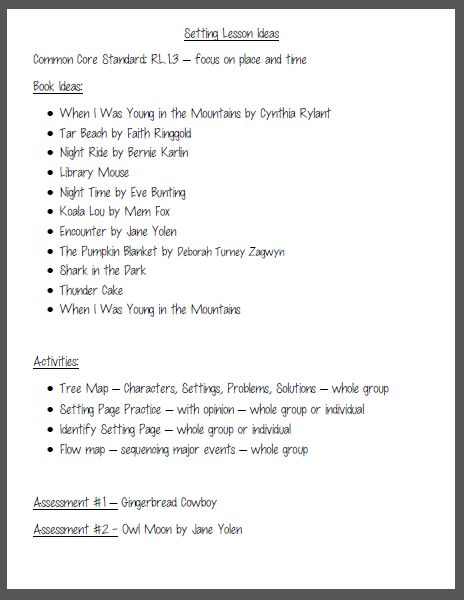
For each reading standard, I like to flesh out my plans adding in book list options, whole group options, independent practice options, etc.  See example below…

Book Lists Tab:
I have done a lot of research and found some great book lists on the internet.  It’s so nice when you’re looking to teach lessons on theme – you can look at the book list under theme – and there are numerous books you can use.  One of my favorite book lists is from Carmela Brown. 

Assessments:
I like having all of my assessments here, which makes for easy access for copying and planning.  Check out my setting assessment package on TPT. 

Thanks for checking out my Reading Plans Binder.  Tomorrow I’ll post my Math Plans Binder.  Have a great day!

Setting Write-Ups and Rubrics – Now on TPT

Literary Elements, Reading, TPT

I just added my packet for identifying story settings to TPT.  In my packet you will find, three different versions of a setting write-up.  The three versions are differentiated for either various points in the first grade year or for use in kindergarten and 2nd grade.  In addition to the setting write-up pages, the packet also includes story ideas and a reading checklist and writing rubric to use for scoring.  This packet fits in with the ELA Common Core Standards and focuses on not only identifying the setting, but also providing text evidence that supports the setting choice.

 
Check it out on TPT here…


Here are two student examples from the past school year. We used this form throughout the year in first grade and as the kiddos got better at writing the setting and text evidence we took away some of the sentence frames.  These two examples are from the first quarter of first grade, so you’ll see the sentence frame in there for the kiddos to use.  At the end of first grade, we required students to identify and provide evidence for two settings (also an option in the TPT packet).


Thanks for checking out my first TPT packet!  Have a great night!
 

Compare and Contrast – Part 2

Reading, Thinking Maps

After spending time comparing and contrasting objects, we moved on to comparing people.  To introduce comparing and contrasting people, my student teacher and I decided to have the kids compare us.  So we gave them some time to come up with similarities and differences and then had them share out.  They know us pretty well and some of their responses were pretty funny. For example, one of my kids said the student teacher wears make-up and I don’t. Little do they know I do and it would be a scary sight if I didn’t lol.  To chart our similarities and differences we used a double bubble – see below…


The next day we gave the kids a chance to complete a double bubble map with a friend. Since they saw the student teacher and I model the double bubble the day before, they were familiar with the activity.  They had a lot of fun seeing what was similiar and different about each other and did a great job working together and completing a double bubble map.  See examples below…


Compare and Contrast – Part 1

Reading, Thinking Maps

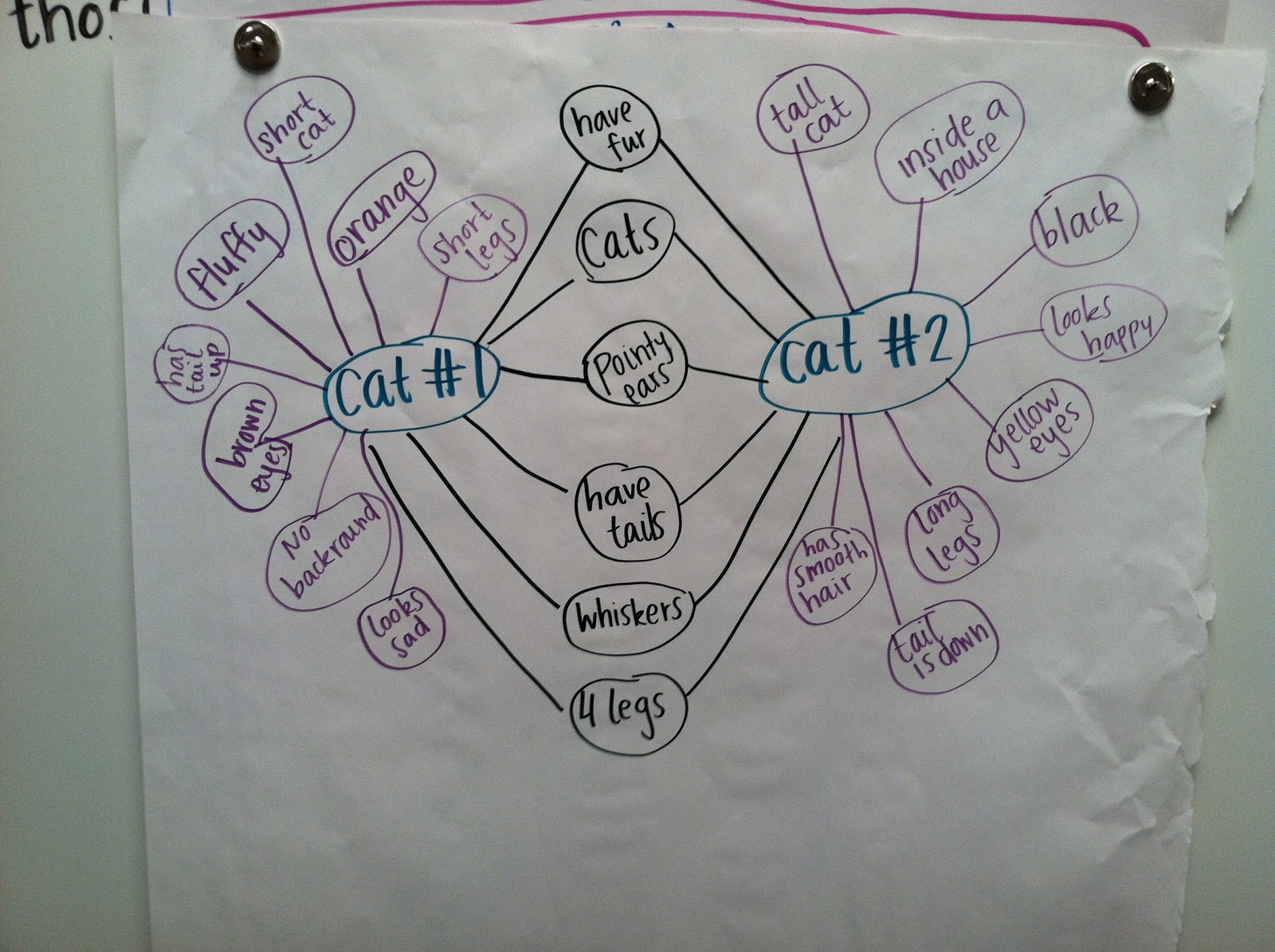
This week in first grade we started tackling the Common Core Reading Standard – 1.RL.9 – Compare and contrast the adventures and experiences of characters in stories.  To start teaching this standard, I decided to use real life objects to get the kids used to comparing and contrasting before we started using text for our comparisons.  On the first day, we talked about the definitions of compare and contrast and things you could compare and contrast – people, books, movies, characters, TV shows, food, etc.  Then, we looked at a SmartBoard file with a picture of two cats. The kids had to discuss things that were similar about the two cats and things that were different. To chart our results we used a double bubble map – see below…

SmartBoard File with Cat Pictures
 
Double Bubble Map for Comparing and Contrasting Cats
 
 
On the second day, we reviewed comparing and contrasting and reviewed the lesson from yesterday. Then, we showed the kids pictures of two dogs.  Again we discussed similarities and differences between the two dogs and reviewed how to set up a double bubble map. After review, the students took the activity a step further and created their own double bubble maps. See examples below…
 

 SmartBoard File with Dog Pictures
 
Student Examples: