Reading
Check it out….
Next up is the calendar. This is an example from last year. I wanted to show one filled out. I use this monthly calendar as a way to map out reading for a quarter or a few months at a time. I like being able to see it all on one page. Here’s where I put down what phonics skill we were working on, reading standard, and also writing standard. From this, I would come up with daily plans and weekly lesson plans, but I had this with me to show the big picture.
What are some of your favorite new kid’s books? Share in the comments below…
Over the first half of the year in 2nd grade, we have spent a lot of time working with informational text. While some of the text features have been easy for the kids to identify and use, some have been more difficult. So one morning we worked together to make a Text Features Anchor chart using clippings from National Geographic for Kids, Time for Kids, and the regular Time Magazine. What I love about this is the kids have been referring to it while on their text features hunt at literacy stations. I love anchor charts for this very reason and it’s even better when the kids remember to refer to it on their own!
Learning about Settings
Anchor Charts, Common Core, Literary Elements, Reading, Thinking Maps November 14, 2013We’ve continued our study of Common Core Standard 2.RL.1 and have moved on to focusing on the where question – the setting. For setting, I found some great picture books that have a very descriptive and easy to identify setting to start with. I’m teaching mainly ELL students so I didn’t want to confuse them with too many settings. Even though the setting was semi-easy to identify I still wanted my kids to use text evidence to back up their setting choice. To show text evidence, I used a brace map (thinking maps) and then also had students write a sentence response.
The first story – Library Mouse we read whole group and discussed the setting and evidence together.
The second story – Gingerbread Cowboy – we read whole group, discussed, and completed a class brace map together.
For the last story, for now, I used The Tickly Octopus. Now, I thought this would be a good one to see what kids could do independently on their own, but they struggled a bit. I’m not sure if it was because of being ELL or just not having a lot of background knowledge, but kids had a hard time saying the setting was the ocean or the sea and they had difficulty coming up with evidence – fish, water, sand, octopus, coral, etc. But, we move forward and will come back to setting again to re-teach as necessary. Below are a few samples of student work and the chart we filled out after they completed their student work.
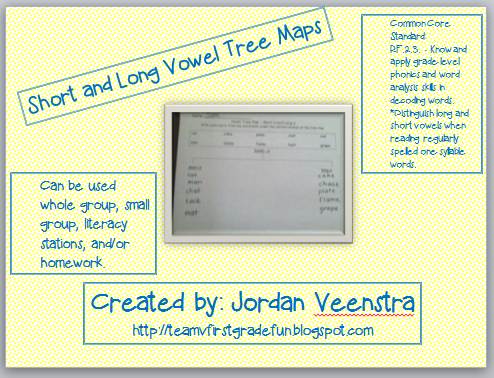
I have a new product in my TPT store that I am excited to share with you! We’ve been working on reviewing short and long vowels in 2nd grade and I love to use thinking maps, so I thought, why not combine the two! So, I created Short and Long Vowel Tree Maps, which is now active in my TPT store.
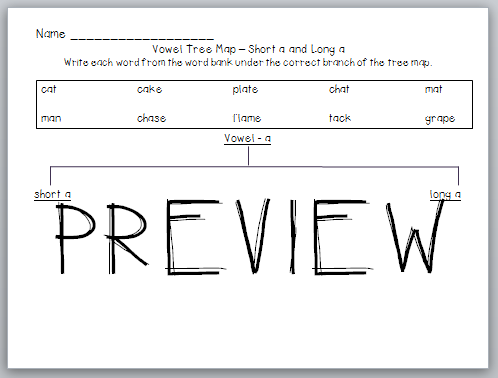
In this pack, you’ll find tree maps for each vowel – a, e, i, o, and u. You’ll find two pages for each with a word bank and one page without a word bank so students can come up with their own short and long vowel words. I’ve used it a few times for homework and also during literacy stations. This is a great way for kids to practice reading the words and also having a chance to sort them.
Here are a few preview pages and a sample for you to see.
Thanks for stopping by and please check it out in my TPT store, here.
I love, love, love teaching literary elements. We’ve continued to work on analyzing characters the last few weeks and below are a few lessons I’ve done with my 2nd graders.
Another great character book is No David. We read the story together in class and they created a bubble map describing David.
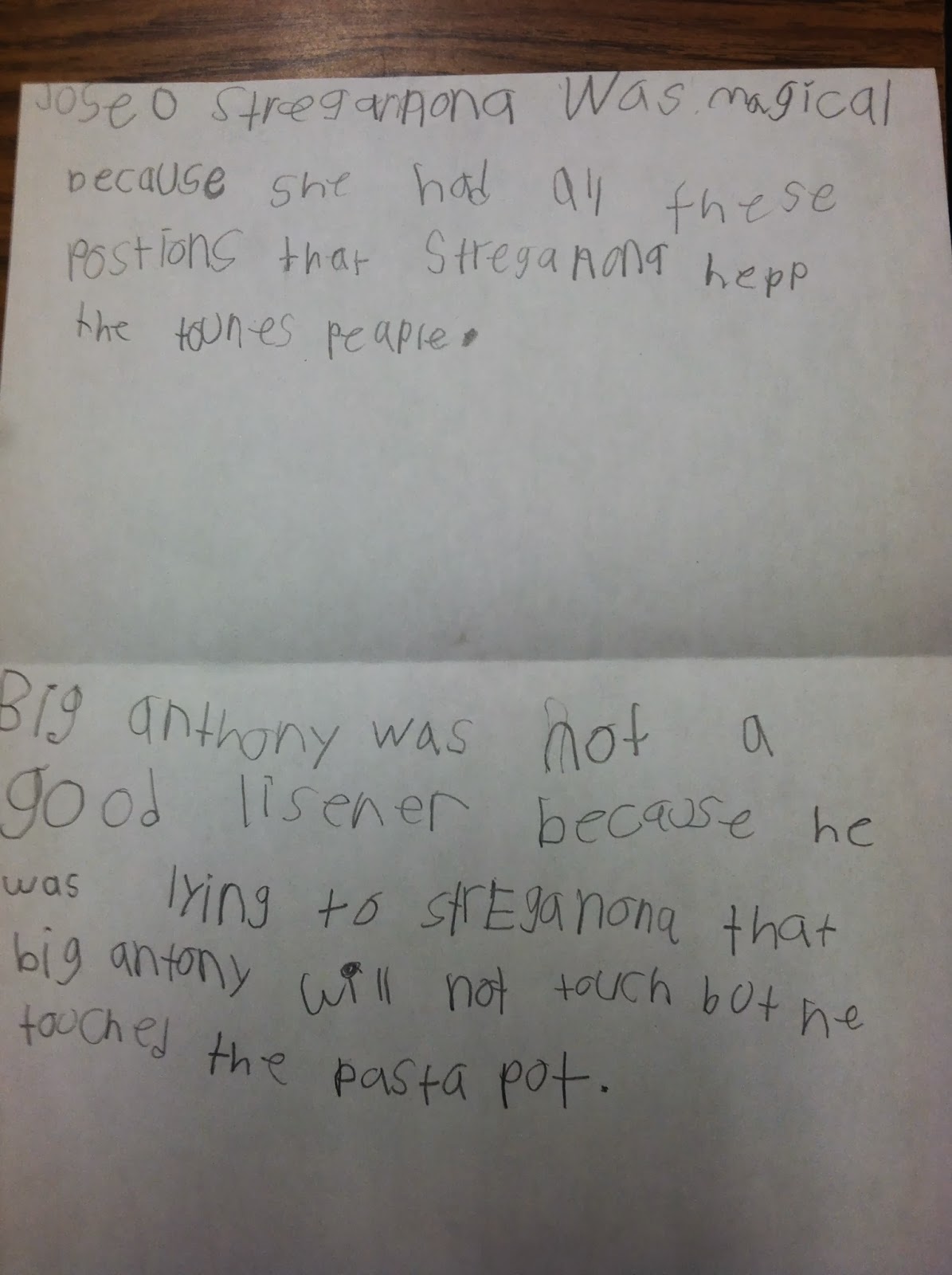
Next up on the reading list, we read Strega Nona. This is a great book for characters and for comparing and contrasting the two main characters, Strega Nona and Big Anthony. We read the story, completed a bubble map for each character, and then the students had to write down one of the traits and provide text evidence for the trait.
And, the most recent story we used was Chester’s Way. After reading, we created a circle map for all of the characters. We used stars or little clouds to show which characters were the main characters. Then, students picked the main character that they were most like and told why.
Using Time for Kids to Learn About Bats
Informational Text, Nonfiction, Reading, Thinking Maps October 16, 2013We are very lucky and have a Time for Kids subscription for each class at our school. Time for Kids is a great way to incorporate informational text, learn about text features, and write informational responses. On Friday, we read the recent Time for Kids issue about bats.
As we were reading, we talked about text features. We spent time looking at the headings, fact box, glossary, photographs, and captions, and the kids are starting to pick up the text features on their own. When we were done we started a circle map about bats and added the facts learned from Time for Kids. After adding those facts, we read an informational book about Bats. Then, we added more facts. The kiddos loved learning all of the cool things about bats and the pictures in both the article and book were awesome.