Browsing Category

Math

Awesome Math Website for K-5

Math
Are you looking for new math games and activities for your students based on grade level and standard??? If so, I have a great resource for you. It’s called K-5 Math Teaching Resources.  This website is amazing!

It has activities broken down by standard – Number, Geometry, and Measurement/Data. Then, from there you pick the grade level.  Now, some of the games and activities can be purchased in their centers packs, but many are still free for download.  They also offer read aloud book suggestions for the different standards.

If you teach math – K-5, I highly recommend you check it out!

Follow me on…


Five for Friday – July 22

Math

I’m back for another edition of Doodle Bug’s Five for Friday. This has been another busy, fun summer week. Check out what I’ve been up to below…

In my 2-3 Math Workshop this week, we worked on multiplication and the older kiddos worked on 2-digit by 2-digit multiplication. I absolutely love the two strategies above. The Window Strategy and Partial Product Strategy are great because they lay everything out neatly, organize, and make it clear what each number represents! I wish I knew this strategy when I was a kid. I think I would have understood multiplication much better if I did.

In my K-1 class, we worked on subtraction.  We played the game Race to Zero.  Students start at 100 and roll the die. They then subtract that number. They keep track of their equations and the first one to zero wins the game! Quick, easy way to practice subtraction!

Wow! So glad I went to the 2016 Vegas Teacher Meet-Up at the Venetian this week. This was my first teacher meet-up and I was a little nervous, but met these sweet girls right away.  It was a great night talking teaching, dancing with GoNoodle, and winning door prizes!

Ah it’s almost that time again – back to school! Teachers report back August 15 and kids start one month from today! I feel like summer is going way too fast! Since we’re on the fast track to school starting, I’ve started working on my long-term plans for the year. So far, I have reading, phonics, and social studies done.  On the to do list this weekend is math, grammar, and writing! I’ll share my plans once I have them finished!

Last weekend, Andy and I went to San Diego.  What a nice weather change! The three-digit temps in Vegas can get a little wearing as the summer goes on, so the 75 degree weather in San Diego was amazing. We had a great time at Seaport Village and Mission Beach.  Love taking summer trips!

Hope everyone has a great weekend!

Follow me on…


Quick Number Sense Activity

Math
Today I’m going to share a very quick number sense activity.  This activity is quick and seems simple, but it is a great formative assessment and it can tell you a lot about a child’s number sense.  This activity is called “Ways to Make…” 
For this activity, students are coming up with as many ways as they can think of to make a certain number. I always do an example with them before we start so they understand the directions. When I do an example, I make sure to pick a smaller, easier number, and also make sure that when they do it independently, they’re working with a different number.
For example, here’s a class one we did together on the white board – Ways to Make 10.  Students can come up with addition, subtraction, multiplication, and division sentences that equal ten.  They can use multiple addends and operations.  For example 20-15+5 = 10.  They can represent ten in other ways – two nickels, one dime, ten tallies, etc.
Here’s a second class example using the number 20.  
Here’s an example of a soon-to- be 4th grader from my summer math workshop class. He was showing Ways to Make 50. As you can see, he used a variety of operations and multiple operations in one given number sentence.
I often use this activity at the beginning of the school year to get an idea of where each student is at with their ability to use numbers flexibly.  This can be used as a formative assessment, partner activity, whole group activity, and in a math station. To differentiate, I often will give kids choices. For example, they could pick the number 20, 40, 80, 100, or 200. This allows kids to have choice and also pick a number that works for them.
Just a quick share today.  Hope this can be helpful and you’ll be able to use this in your own classroom!

Follow me on…


Missing Factors – Multiplication Practice

Math
After working for a few weeks on different multiplication strategies, we started working on finding the missing factor.  This was my first year teaching this skill and to be honest I wasn’t exactly sure where they’d take it. I first posed a problem to the group in a number talk and let them share out their strategies while I documented them on the board. I was majorly impressed by what they came up with. Because of their ability to think flexibly with numbers and their variety of strategies and solid understanding of multiplication – they did amazing!
Here are a few examples of strategies used for the problem ___ x 4 = 20. I told them that in addition to writing the answer, they also had to prove it.
This student made an array to show that the 4 rows to get to 20 would have 4 in each row.
This student used skip counting to get to 20. They skip counted by 4 and realized it took them 5 times to get to 20.
This student used a number line to jump up by 4 each time and see how many times they had to do that to get to 20.
This student used a combination of skip counting, but also had it clearly marked after so you could see where they got 5 as their answer from.
After working on this during whole group instruction for a day or two, students participated in “Find the Missing Factor Around the Room” This product is now up in my TPT store. I love Around the Room activities because it gives kids practice on a certain skill, but it’s not just a worksheet. Students are able to go in any order they want and they’re up and moving.
Here’s an example problem and the recording sheet:
Check it out in my TPT store here.  Finding the Missing Factor Around the Room includes 16 cards, a recording sheet, and answer key. 
Find the Missing Factors - Around the Room

Follow me on…


Multiplication Story Problems

Math

One of my favorite things to teach is math. And, I love teaching it this time of year because this is when we start multiplication in 2nd grade. The kids are always so excited and eager to learn how to multiply. There’s just something special about multiplication.

I love to start new math content with story problems when possible and love to use them throughout the units. Story problems are also a part of our standards, but they’re also a great way to provide context and help improve understanding with math. 

These examples below are after a few days of multiplication. I love seeing the variety of strategies used and love that the kids are using strategies that work for them. 


This student represented the multiplication problem with an array and used the array to help him solve the problem. 
This student drew out the groups to help her solve. I also love how she clearly labeled the trays to keep things organized. 
This student used the combination of an array and skip counting. 
And the last example used repeated addition. Love how he summed it up at the end after showing his work.
Those are just a few examples. When students are done independently solving, I pick a few to share their work with the class under the document camera. This gives them a chance to explain their thinking and also learn from each other. Story problems are done at least once a week in my classroom so that whole word problem fear is nonexistent. My kids actually enjoy doing them!
Do you use story problems to teach math?


Follow me on…


TenMarks

Math
I’ve been a horrible blogger as of late, but I’m trying to get myself back in the habit of blogging.
 
Today I want to share with you a website that is awesome for homework and could also be used for quizzes.  I was introduced to TenMarks in August.  My new school uses it for a few different things, but mainly for online math homework. I love, love, love this site!  And, the best part of all is it’s FREE!  They do have a paid subscription part as well, but the free items work perfectly!
 
Here’s how it works….
 
First, you log in and set up your teacher account. Then, you create your class and add your students. Each student will have their own log-in and password so they can access it in class or at home.
 
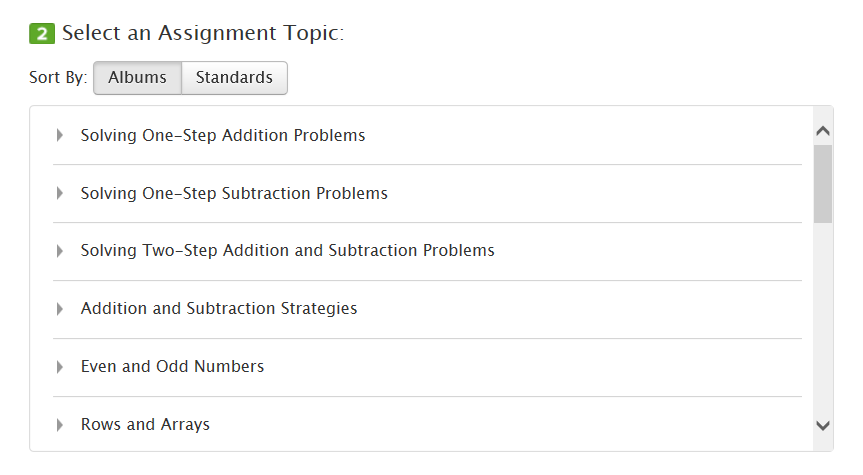
Then, you create assignments!  The nice thing about this the assignments are tied to the Common Core Standards.  (We don’t use Common Core at my school, but you can find activities based on standards or topics).  You can even preview the assignments before you give it! 
 
When you go to create assignment, you can choose to assign to your whole class or can give an assignment to select students (perfect for differentiation).
 

 Assignments can be picked looking at topics or Common Core Standards.


Once you give the assignment it shows up on each student’s page when they log in.  A perk for students is that it does offer hints and also has videos to show skills that they maybe don’t understand or need a quick review on.  It also allows you to correct your mistakes after the initial assignment is completed.
 
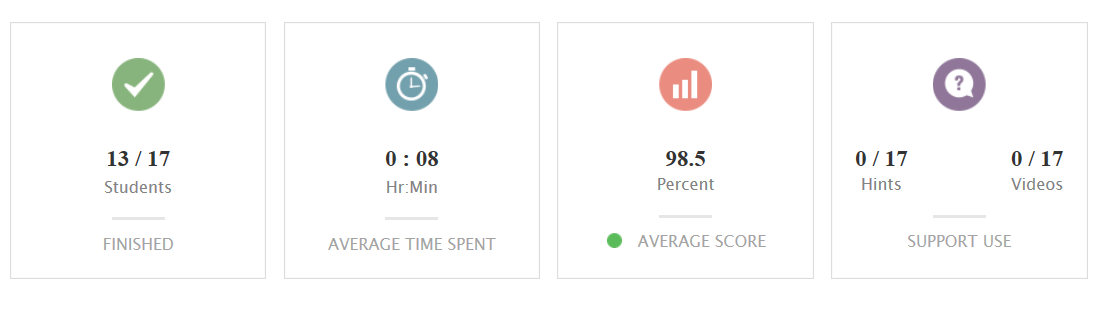
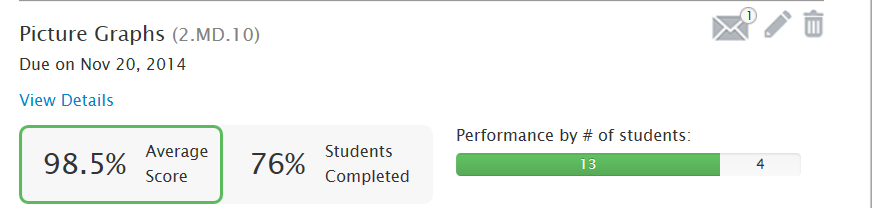
As a teacher I like that it provides students with online work practice.  Many assessments and things in life have gone to online so it’s good for kids to be familiar with how to answer questions online.  It also provides me instant results and I don’t even have to grade it! It grades it for me.  In addition to results, it shows me the child’s score, the time they took to complete it, and also breaks down areas where students struggled in a lovely chart.  See below…
 
Quick info that shows how your class did as a whole.
 
More class info…. (it gives individual info too, but to protect student privacy I didn’t get a picture of that part).
 
It even breaks down the Top 3 Mistakes that students had.
 
So, if you haven’t checked out TenMarks – check it out! It’s free and a great way to give homework.  In second grade, we have math homework 4 days a week and we use TenMarks 1-2x per week depending on what we’re covering.
 
 
Anyone else use TenMarks? Let me know what you like about it in the comments.


Follow me on…
 

Addition Strategies

Anchor Charts, Math
I posted briefly in my Five for Friday about our addition strategies that my second graders have been using, but I had to share more.  Most of my kids have basic knowledge of the standard algorithm because of old math programs, etc.  Yet, they really don’t understand addition. They have no idea why they’re carrying a ten, they don’t know when it’s a ten or a hundred, etc.  Same thing I did when I was in school.  Well with Investigations and with my background with Cognitively Guided Instruction among other things, we’ve been working on using different strategies so kids really “get” why they’re adding. 
 
Here’s our anchor chart we created to show our strategies…
 
 
On Friday, we completed some story problems because I wanted to show parents at our conferences on Monday how many different strategies there are and how the kids are really understanding their math. The kids did amazing! I’m so proud of how they have taken to these strategies.  When we practice addition on our white boards with the strategies, the kids actually groan when it’s time to clean up and beg me to do it every day lol.  I love to see them so excited about math.
 
 
Here are some of their strategies they’ve been using….
Place Value Model
 
Empty Number Line
 
Break Apart
 
Expanded Notation

Hope everyone is having a great weekend! 

 
Follow me on…

Math Planning Binder

Math, Organization

I blogged about this last year, but wanted to update it for the new year and also explain a little more about how I used this.  Last year, I started using a math plan and reading plan binder. I’ll blog about the reading one tomorrow.  I found this binder so helpful when doing long range planning and then to use for the weekly lesson plans as well. 

Here’s what’s inside…

Cover

 
Tabs – Standards, Calendar, Plans, Book Ideas, School Mapping

 
First up, the standards. The basis for planning. I’ve updated this with  my new school’s standards since they don’t use Common Core.  All the standards are in here and easy to read in a cute font (all of us teachers love our fonts…don’t we?)

 
Next up, the calendar. Here’s a picture from last year. I mainly used this calendar to map out each quarter.  I liked having the monthly calendar in here because it made it easier to see the bigger picture.  After mapping a quarter out, then I could use this calendar to then focus in on the weekly plans which we had to do online at my old school.

 
Here’s my new calendar for this school year. Blank, but it’ll be full before I know it.  I purchased this calendar in A Modern Teacher’s Refill Calendar Pack. Check out her TPT Store, here.

After the calendar, I have the plans tab. In this tab, I have standards broken down into days. This is where I map out the actually lessons, ideas, books, videos, etc to use to teach a standard. I also pull from this to write my actual weekly lesson plans.

My book ideas tab is empty for now.  Need to find some great math book lists!

Last tab is my school’s math mapping. They set down last year and figured out what the different standards would look like in the different grade levels. Since they don’t use Common Core they had to narrow down the specifics for each grade. 


Thanks for checking out how I use my math planning binder.  Tomorrow I’ll explain how I use my reading one!
 
Follow me on…


Teaching Time to the Hour and Half Hour

Math
I taught 2nd grade last year for the first time.  While they were supposed to already know how to tell time to the hour and half hour, I found out through assessment that many of my kids could not do that. So, time for reteaching.  I created this packet, now available on TPT to help my kiddos and yours figure it out.  This packet would actually work great for first grade as it covers 1.MD.3, but for those second or even third grade kiddos that need review, this packet is for them as well.

Find the packet, here.

Here what is included…

 
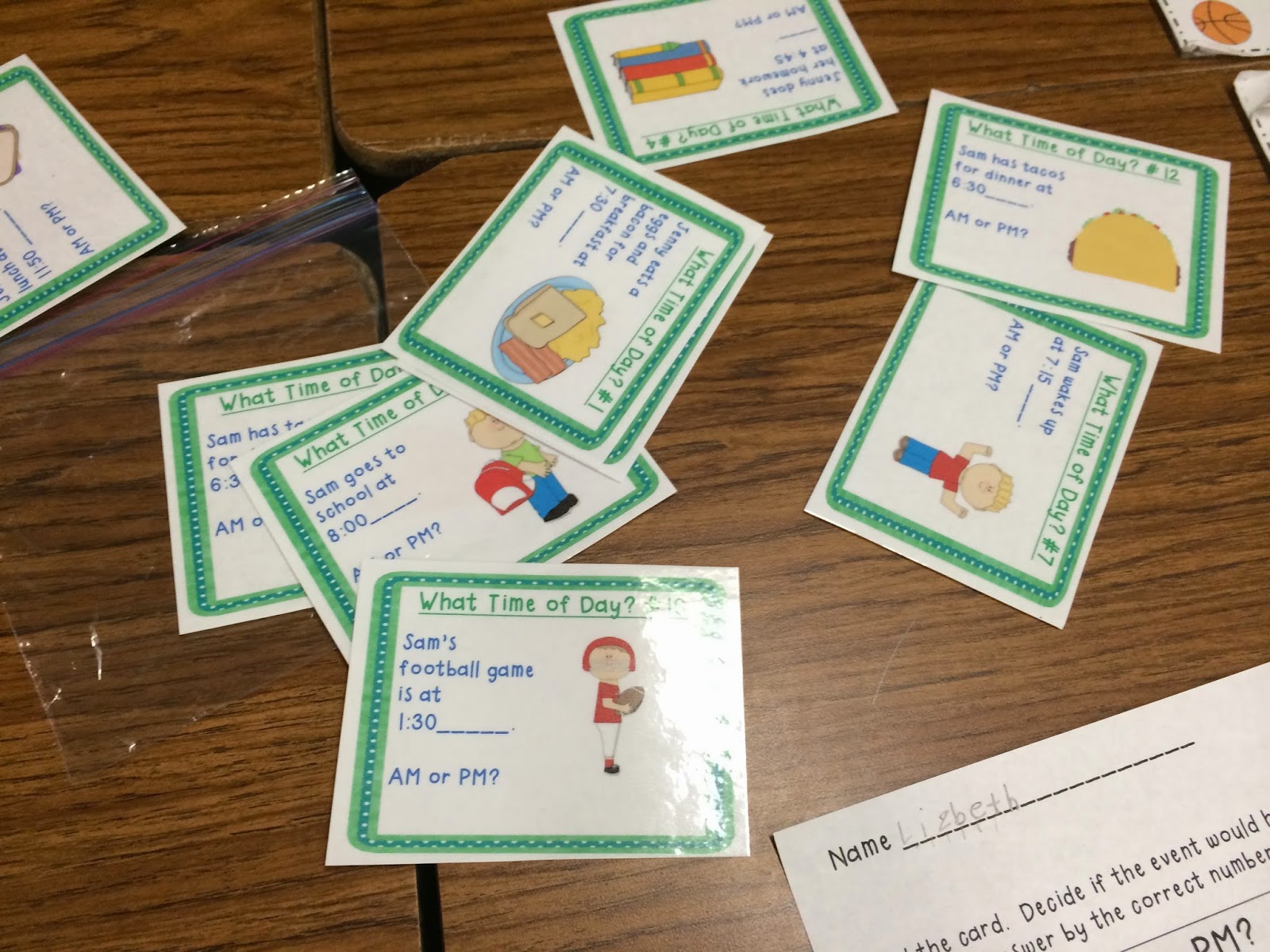
What Time of Day? – This helps kids practice differentiating between AM/PM.


What’s the Time – kids had to read the time on the analog clock and record it. This covers time to the hour.


Pick 4 – Students pick a time and have to draw that time on their blank clock.  Works great as a mini assessment.


Show Me the Time – Students pick a time and then have to model it on their clock.


What's the Time? - Beginning - 1.MD.3 
 
 
Follow me on…


Mental Math Ideas – 2.NBT.8

Math, Math Stations, TPT
Here’s one of the packets I’ve had waiting in my TPT file to finish and update with picture of my kids in action.  This TPT packet focuses on the math standard – 2.NTB.8 – Mental math adding and subtracting 10 and 100 from any number 0-999.  We did this lesson later in the year which I debated was the right timing.  However, I’m glad I waited.  By April/May, my kids had a stronger foundation with number sense for 3 digit numbers so they had an easier time understanding that the only number changing is either in the tens or hundreds spot depending on if you are adding or subtracting by 10 or 100. 
 
Here are some pictures of my kids playing the Mental Math +/- 10 Bingo. They had a great time playing!
 

Here’s another game in my Mental Math Packet.  This game is called “Solve It.” Students flip over a number card.  Then, students flip over a +/- card that tells them to either add or subtract 10 or 100 to the number. Then, students record the number sentence on the recording sheet and solve the problem using mental math.

 
Here’s my pack on TPT – Be sure to check it out – Mental Math Practice
 
Mental Math Practice - 2.NBT.8
 
Thanks for stopping by!