Browsing Category

Math

Division – Tip for Conceptual Understanding

Math
I’m popping on today to share a quick division tip focused on students’ conceptual understanding of division…
We use CGI (Cognitively Guided Instruction) at my school and I am a huge fan! I know this is not the first blog post that you’ve heard me say that. I’ve actually used CGI at multiple schools and have probably been using it for 8 years.  CGI focuses on students really having a solid grasp on the conceptual understanding of a topic. Gone are the days of just memorize a bunch of formulas, but you have no idea how or why you are doing that. That is why I love CGI. The focus is on kids understanding, not just getting the right answer. Now, don’t get me wrong, I do know most math problems typically only have one right answer, but CGI focuses on the understanding and that there can be more than one way (strategy) to get to that correct answer.
I recently used CGI with my summer school students.  Division is a skill that can be hard for kids to understand so we broke it down and made it visual for them.  For the problem below, 18 divided by 6, I had them pull out 18 counters. We discussed that the first number is the whole number of what they are starting with.  You can see this student organized them using the 10 frame (my favorite!).
Then we talked about dividing meaning that we needed to separate them into equal groups of 6. So, they physically moved the 18 counters and separated them into groups of 6.
Last, we counted the number of groups they were divided into and they came up with 3 groups. We also talked about how it was related to multiplication and how they are fact families. The visual made it easier because they were able to see that from their work with the division problem, that the multiplication problem was right there.  On the board, they had three equal groups of 6 which equaled 18.  This visual helped tremendously and helped them make the connection between multiplication and division! 

Day 1 of the TPT Back to School Sale

Math
Yay! The Back to School Sale is finally here! My entire store – Jordan Johnson – will be on sale for 25% off with the code BTS2017.  Check out one of my newer products below! Great for the beginning of the school year.
I know many of us start out with Place Value lessons in the beginning of the school year! My newest bundle (Place Value Bundle) will help provide quick practice in multiple place value skills.  It includes mainly 3 and 4 digit numbers (one Show Me the Number focuses on 2 and 3-digit numbers).  It covers creating place value models, writing numbers in expanded form, writing numbers in standard form, and reading numbers.  The last activity shown – Place Value Review – Around the Room covers those skills plus comparing numbers and adding using expanded form. 
Check it out in my store! It is part of the sale and will be 25% off with the code BTS2017.

Friday Favorites – Math Activities

Math

Every Friday this summer I am sharing some of my favorite things with you! The month of July is focused on technology and academic areas.

Check out past Friday Favorites…
PD Books
Read Alouds
Kids’ Favorite Series
Book Studies

I love teaching math so it was hard to pick just a few of my favorite math activities to share with you, but I was able to do it! The activities I’m sharing below are mostly geared towards second grade, but could apply to high first graders or low third graders. You’ll also notice there are a few activities with food. I find that anytime you can add food to a lesson – the lesson becomes more engaging!  I also try to incorporate as many hands-on lessons and math games as I can to help keep students engaged.

Check out a few of my favorite math activities…

Counting to 1,000 Book – One of the second grade standards is that students are able to count and write their numbers to 1,000.  So for an activity (we started whole group and then students would work on it when they finished work early) I had students write their numbers from 1-1,000. They would do one paper at a time and then I would check it. This allowed for quick feedback and made sure students didn’t get too carried away with incorrect numbers.  When they were finished, it was put together in a book that they could take home.  They loved the fact that they got to decorate the front cover.

Making 2D Shapes – As I mentioned, I like to incorporate food into lessons when I can. I saw this online and can’t remember the exact source, but it worked perfectly. We had been studying 2D shapes and their attributes. As a way to practice, students created shapes using pretzels and marshmallows. This lesson was a hit and the kids loved trying to create the harder shapes with more sides.

Arrays with Skittles – Another great food lesson. I like to break out the Skittles when we start working on arrays.  Students like below can make the array that fits the equation. For example, 3 x 7 – they make 3 rows with 7 Skittles in each row and then count to find the product.   They also enjoy the Skittles when we are finished!

Race to Zero – This is a fun, competitive game that focuses on subtraction and strategy.  Students can play in teams, partners, individually, etc. The goal is to be the first person to zero. Each team gets 3 dice and starts at the number 999. They decide how many dice to roll and then once they’ve rolled, they decide what order to put the numbers in. Then, they subtract. This continues until one team reaches zero. The interesting thing about this game is that it focuses on being strategic and using the right number of dice at the right time and really thinking about the best order to put the numbers in to maximize your turn.  I love having the kids play this for an activity during Morning Meeting.
Lucky Charms Graphing – Back to the food again! I again do not know where I got the worksheets I used, but there are many different Lucky Charms graphing packets out there.  The kids have fun picking out the marshmallows and graphing the totals that they have.  It also gives you a chance to ask some data analysis questions which focuses on number sense, addition, and subtraction.

Create Your Own Graphing Project – This is a fun project that my students always enjoy working on. Once we’ve learned about the different types of graphs, students work with a group on a project where they create their own graph. The group comes up with their survey question, surveys students, creates the graph, analyzes the data, and presents their findings to the class. It’s a great project to use to wrap up the graphing unit. You can find this in my TPT store… Create Your Own Graph Project.

Thanks for stopping by! Next week I’ll share some of my favorite reading lessons and activities!

New Place Value Products

Math
I’m so excited to share some new Place Value products that I have been working on this summer. These are perfect for Fall as most of us start our math units teaching or reviewing place value.  Both of these are geared towards second grade.
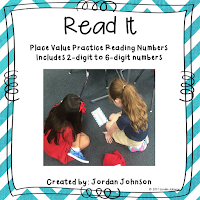
In Read It, students are practicing reading numbers out loud. One of our standards (we use ERB) is for students to be able to correctly read up to 5-digit numbers.  Read It is differentiated and includes practice with 2-digit up to 6-digit numbers.  This is a partner or independent activity. Students can take turns reading the numbers to each other and then pick a new card.

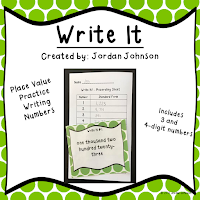
In Write It, students are practicing reading and writing numbers. First, students read the number on the card, which is written in word form. Then, they write the number in standard form on their recording sheet.  Write It includes 3-digit and 4-digit numbers. This activity is best used as Around the Room.
Both activities offer a color version and a black and white version.  Check them out in my TPT store by clicking on the pictures below.  
                             

Five for Friday – May 19

Math

Man…oh…man… the end of school is always so crazy!  Anyone else feeling like they can barely keep up??? Even with all of the crazy, I’m still linking up with Kacey at Doodle Bug’s Teaching for another Five for Friday…

Every year students complete a Think Like a Disciplinarian Project. This an ongoing project that takes the entire year. Students spend time researching their discipline (what it entails, tools, vocabulary, noted practitioners, interview someone in the field), write a report, and then share a presentation with the class. We started presentations this week and I’ve been blown away! The kids have all done an amazing job! Here are two to share – one student who did a poster about being a baseball player.  The other student studied being a chef and brought in her own recipe! Love the creativity!

We’ve been working on fractions this week. I love Amy Lemon’s Fraction Fanatic packet on TPT. If you teach fractions and are in 2nd grade – this is a great resource! I also love these flip books from Lakeshore. Great practice of matching up the fraction, picture, and picture representation of the fraction in sets.

Our awesome headmaster gave us a nice treat this week! He had a Coffee Bean catering truck on campus Tuesday morning.  The entire staff was treated to yummy drinks and pastries!

Here’s a quick formative assessment idea…one of our standards is students being able to identify 2D and 3D shapes and compare and contrast two 2D shapes.  We do have a paper assessment, but I also like to have the kids come back and test them one on one. I use the picture – they identify the two 2D figures. Then, they identify the two 3D models.  Last I have them compare and contrast the two figures on the page.  It’s quick, simple and I like that I get to discuss it with them.  Paper assessments are great too, but I do enjoy the observational assessments too!
Last weekend, my husband and I checked out Top Golf Las Vegas! What a fun place! Lots of golf options, pools, concert venue – it has it all! Do you have a Top Golf near you?
Have a wonderful weekend! 8 days to go with kids!

Multiplication Strategy – Teaching Tip

Math
So as I have posted about many, many times – I love Cognitively Guided Instruction for Math. The emphasis of CGI is building conceptual knowledge and a solid foundation of math skills.
Anyways..I wanted to share quick tip for double and triple-digit multiplication by single-digit.  It’s the break apart method.  (I do also use break apart for adding and subtracting).
For multiplication, students break apart the larger number (usually the 2-digit or 3-digit number).  Then, they multiply those numbers by the single-digit number.  Once they’ve multiplied each number they broke apart, they add up what they got and find their product.
For example, in 493, my student broke it into 400 + 90 + 3. Then, she multiplied 400 x 5 and got 2,000.  She multiplied 90 x 5 and got 450.  Last, she multiplied 3 x 15 and got 15. She added all those numbers together to come up with her product of 2,465.
This tip is helpful to students because they see where each number is and where it comes from.  Instead of the old method of stacking, where it gets confusing what the value is of the number, break apart allows students to clearly see what is the hundreds, tens, etc.
Just a quick math tip for today! Hope everyone is having a great week!

Guess What?

Math, Reading, Writing

The TPT Big Teacher Appreciation Sale begins tomorrow! You heard me!! Tomorrow!  My entire store – Jordan Johnson – will be on sale May 9th and 10th for 28% off with the code THANKYOU17.  This is a great time to stock up on some goodies for the end of the year and for early planning for next year.

Download for Facebook - 740 × 400

Check out my Instagram to win a $10 gift card that you can use on the sale – Team J 2nd Grade Fun.

Check out some of my bundles below…

Grammar Fix It Bundle – Provides practice with capitals, end marks, apostrophes, commas, verb tense agreement, quotation marks, and spelling high frequency words.  6 products make up this one mega-bundle!

Grammar Fix It -  BUNDLE

Nate the Great Bundle – Includes two Nate the Great Book Studies (Nate the Great Goes Undercover and Nate the Great and The Lost List). Perfect for small group book studies.

Nate the Great Book Study BUNDLE

Graphing Galore Bundle – Includes 3 of my popular graphing products – Graphing in 2nd Grade, Learning About Line Plots, and Create Your Own Graph Project. Perfect for covering the 2nd Grade Data Analysis standards!

Graphing Galore BUNDLE

These are just a few of my bundle products! Add them to your wishlist today and purchase tomorrow in the sale! Happy Shopping!

Five for Friday – April 28

Math, Project Based Learning

Wow! Where did the month of April go? Summer will be here before we know it! I’m linking up with Kacey over at Doodle Bugs Teaching for another Five for Friday. Here’s what we were up to this week…

We started our next PBL this week.  For this PBL, students research important figures in history – George Washington, Abe Lincoln, Martin Luther King Jr., and Rosa Parks.
This week students found out who they were researching and started brainstorming questions about their person.
We also got started on research this week.  Students use books, online text, and videos to research. This kiddo decided to organize her information using a tree map! Can’t wait to see where this project takes us!
Oh my goodness! I would love to speak to whoever created these “fidget spinners” and ask them what they were thinking. Since spring break, these things have been coming into my classroom and multiplying every day! And, I love when I tell the students no they can’t have them, that they tell me it helps me focus. I call baloney on that. They only thing it’s done is distract that child and the children near them.  I just don’t get it!  Rant over… lol

This week we started reviewing for our upcoming standardized testing. I broke our math standards down into categories and we’re focusing on a different area each day. For place value, students completed Place Value Around the Room. I’m changing up the way we review the material each day to make it a little more fun.  Check out my blog post on my Place Value Review…here…

Last Friday we had our big Earth Day celebration at school and yesterday we had Field Day. Here are the cute shirts the staff and students got.  We had five different activities and the grade level classes competed against each other.
My school celebrated Teacher Appreciation Week this week. How cute is this basket! It was filled with all kinds of teaching goodies!
Peanut Butter M&M’s are my favorite candy, but what’s funnier is my student with the peanut allergy was the one who brought me these.  Cracked me up!

And how adorable is this! I love this memento from my class.

Hope everyone has a wonderful weekend! Summer is almost here!

Place Value Review

Math

It’s that time of year for many schools, teachers, and students – the dreaded standardized test! We don’t use Common Core at my school and I teach at a private school, but we still have a standardized test that we take at the end of the school year – the CTP4.

The week or two leading up to the test I like to review especially our math skills from the entire year! I wanted to make it fun for the kids and to keep it interesting so I decided to first break each area down. I decided to focus on a different strand/topic/whatever your school calls it each day.

So, the first day I reviewed place value.  For place value, I created a Place Value Around the Room.  It is in my TPT store…here…

product_0

This Place Value Around the Room covers writing numbers in standard, word, and expanded form, adding numbers using expanded notation, being able to read a place value model and draw a place value model, and comparing numbers (using < = >),  This pretty much covers everything we focus on for place value and focused mainly on three-digit to five-digit numbers.

Check out a few of the cards….

What standardized tests do you take at your school? How do you review?  Write your answer in the comments section!

Quick Teaching Tip – Multiplying by Multiples of 10

Math
I have a super quick math CGI (Cognitively Guided Instruction) tip to share with you today…
Recently my students were working on multiplying by multiples of 10.  We started off by first discussing what a multiple of 10 was – 10, 20, 30, 40, and so on.  Now, I know there is the way we learned where the teacher taught us to just multiple the two numbers – so in 8×60 – 8×6 and then add 0 to the end – so 48 and 0 would be 480.  While technically this works, it doesn’t really show students where the numbers come from and what they represent.
So, I did a quick visual for my kids. We talked about 8 x 60 means you have 8 groups of 60.  So we drew 8 groups of 60 (6 tens sticks for each group) and then counted up by 10s until we got to 480. 
Then, I also showed them that you can use your basic facts to help you. Since you know 8 x 6 =48 then 8 x60 would be 480. So while I do show them the “trick” I also do many examples with the drawing of the place value model so they really see where the numbers are from.  Some of my students who need visuals actually prefer to draw it out.  It helps them to see all of the numbers.  The visual especially works for the kids who are still learning their multiplication facts.
Hope you find this quick tip helpful!