Browsing Tag

Writing

Differentiation in WW – Tip #1 – Writing Pre-Test

Uncategorized, Writing Workshop
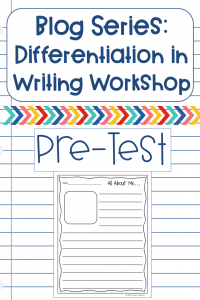
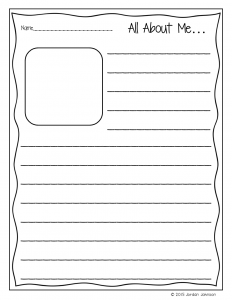
I am so excited to be sharing my first differentiation for Writing Workshop tip with you today.  If you missed my intro to this new blog series click here >>> Introduction. So before you can actually differentiate for each child in your class, you need to know where they are as a writer.  You need to know their strengths and things that they can work on.  One way to quickly figure this out is by giving them a writing pre-test. If you use Lucy Calkin’s Units of Study, she has pre-test ideas in the Writing Pathways book.  She calls them On-Demand Performance Assessments.  If you don’t have the Units of Study, you can still have your students complete a writing sample/pre-test.  At the beginning of the year, I have my students write about themselves on the page below. From this writing sample, I can learn a lot about each student.  For example…
  • Do they use complete sentences?
  • Am I able to read their spelling and inventive spelling?
  • Are they able to stay on topic?
  • Do they use capitals and end marks correctly?
  • How is their handwriting?
  • Do they add details?
Those are just a few questions I can typically answer by looking at this writing piece.  Now – this helps me differentiate for students because from this I am able to make individual goals for each student.  Some students might need to work on adding details to their writing pieces while others might need to focus on conventions. To be able to differentiate it’s important to know where you students are.  It’s also important to have a sample from the beginning of the year so you can see the growth and progress they make by the end of the year. Stay tuned….on Monday I will be sharing Tip #2.  I will be talking about differentiating with mini-lessons.  

FREE Writing Checklists

Picture of four writing checklists.
To make your life easier I have a FREE set of writing checklists for your students to use! These are geared towards the primary grades and include 8 different checklists – so you’ll be able to differentiate based on what you’re teaching and your students’ needs. Grab your writing checklists HERE.

New Blog Series – Differentiation in Writing Workshop

Writing Workshop

I’m so excited to share with you a new blog series that I’m starting called Differentiation in Writing Workshop. I am very passionate about teaching Writing Workshop and have been teaching it my entire career in grades first through third. Through the years, trainings, and books, I have come up with some ways you can differentiate Writing Workshop in your classroom to reach all learners.

Here is what the series will include:

  • How to use writing pre-tests
  • Mini-lessons to fit your class’s needs
  • Choice in paper and topics
  • Effective ways to use a mid-workshop interruption
  • Word walls
  • Editing checklists – differentiated
  • Anchor charts
  • Strategy cards as a differentiation tool
  • Individual conferences
  • Students creating their own goals.

Check back Thursday for a new post in the series about how to use writing pre-tests to help differentiate Writing Workshop for your students.


Quick Comma Intro

Writing


Commas has been on our class schedule for multiple days and each day it got pushed because something ran long. While commas are important and do have their value, as we know we often run out of time in any given school day.  Anyways – the kids were excited because we finally, finally, finally got to talk about commas the other day.

Now, there are many different times we need commas and it can be a bit overwhelming. To start, we watched the Brainpop Jr. (maybe it was Brainpop) video about commas.  Moby is always entertaining and the kids enjoy learning along with him.

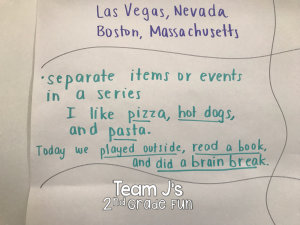
After watching the video, we started a class anchor chart about commas.  As I mentioned there are many times to use commas, but to make it a little less overwhelming on Day 1 we focused on three specific times.  On the anchor chart, we talked about using commas for the date, between city and state, and when listing items or events.  I put up each instance and we also came up with an example or two that matched that situation.
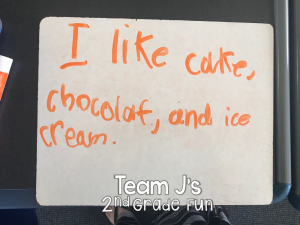
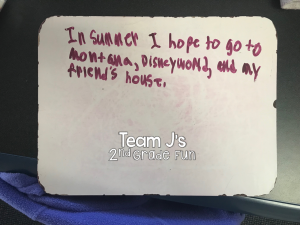
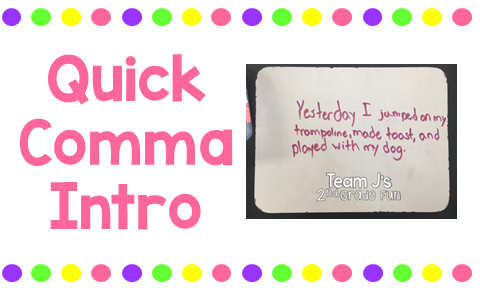
Then, since we were running out of time again and almost late for library, I gave a quick exit ticket type assignment. I had students go back to their seats and write down a sentence using commas as a list on their white board. I wanted something that would be quick, but also something that I could do a quick check that would be a formative assesment.

It went great! The kids wrote their sentences and headed to library. While they were at library I went around to see if they understood how to use commas correctly in a list and almost all of them did.  Then, they returned from library and their sentences out with their table group.
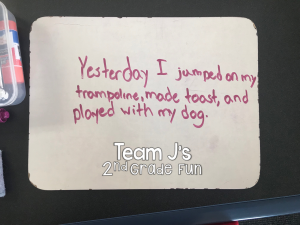
          

So super quick, easy way to introduce commas and a great way to do a quick check for understanding.

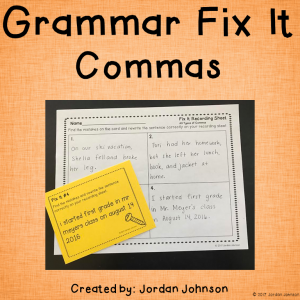
If you’re looking for more comma practice, check out my Grammar Fix-It Commas product.

Grammar Skills Included:
• Commas separating single words, capitals, and end marks
• Commas separating cities and dates, capitals, and end marks
• Commas used in introductory phrases, capitals, and end marks
• Commas used in compound sentences, capitals, and end marks
• All types of commas, capitals, end marks, and apostrophes (possessive nouns and contractions)